
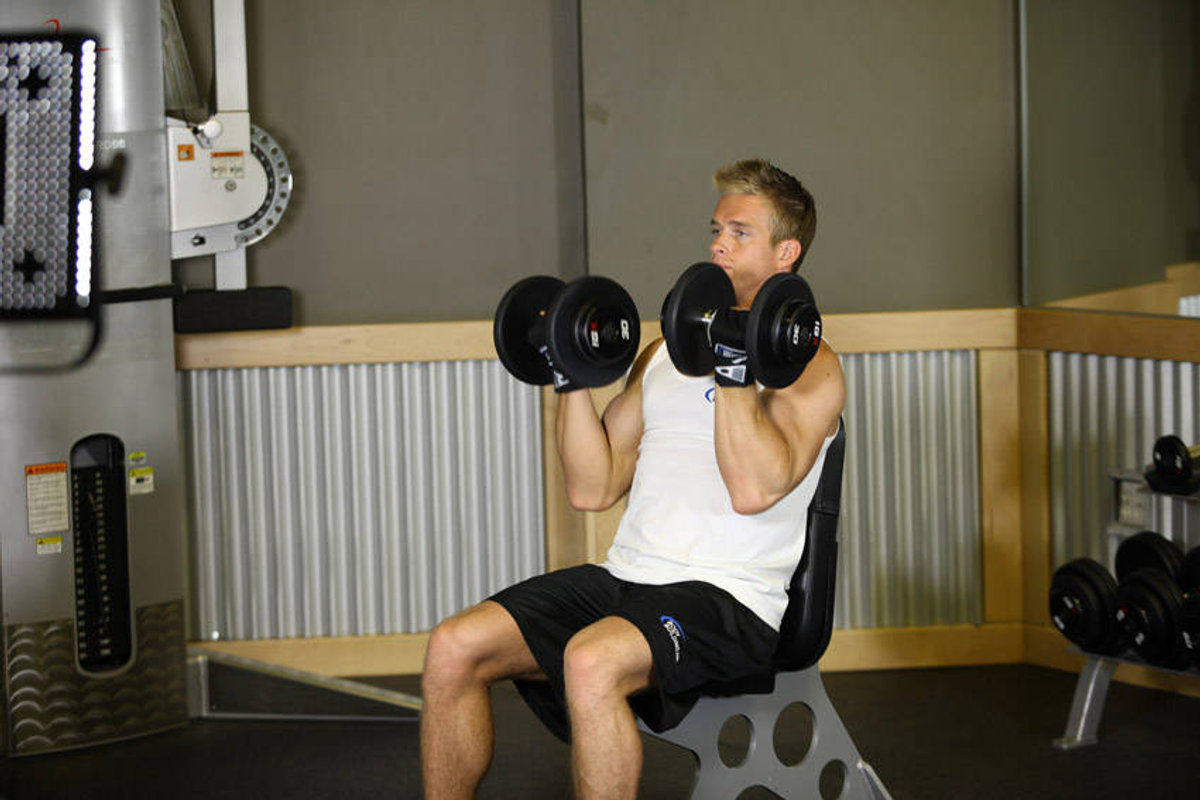
Arnold Dumbbell Press
Safety Rating for 40+
Benefits for 40+
The rotation component trains all three deltoid heads in one movement – time-efficient for 40+ trainees who need to distribute volume smartly. The controlled internal-to-external rotation promotes shoulder joint mobility, counteracting the increasing capsular stiffness after 40. The obligatorily lighter weight results in more moderate joint loading than standard shoulder press.
Form Cues
- Start position: dumbbells in front of face, palms facing you
- Rotate outward while pressing – palms face forward at the top
- Controlled tempo, lighter weight than standard shoulder press
Common Mistakes
- Decoupling rotation and pressing – the turn must be synchronized smoothly with the press
- Choosing weights too heavy – the rotation requires significantly lighter loads than standard shoulder press
- Lowering elbows below 90° in the start position – overstretches the anterior shoulder capsule, which may already be shortened in 40+
- Fast, uncontrolled tempo – the rotation component requires slow, deliberate execution
Modifications
Beginner
First practice only the rotation without pressing (rotate dumbbells at shoulder height). Then add half ROM. Only full range of motion once coordination is clean.
For Joint Issues
For shoulder impingement: skip this exercise – the combination of rotation and overhead movement is risky with narrowed subacromial space. Instead: seated dumbbell press with neutral grip or landmine press.
Advanced
Perform standing for additional full-body stabilization. Alternatively: with resistance band around wrists for enhanced external rotation activation.
Scientific Basis
The rotation component activates all three deltoid heads in one movement. Tier 2 because the additional rotation requires higher coordination and places greater shoulder demand. Choose lighter weight than standard DB press.
Contraindications
- Shoulder impingement – the rotation-press movement under load can worsen symptoms
- Rotator cuff instability – dynamic rotation under pressure significantly stresses the cuff
- Limited shoulder mobility – full ROM requires adequate internal and external rotation
- Acute wrist issues – the rotation component adds wrist stress
Related Exercises
Related Guides