Glute Bridge
Safety Rating for 40+
Benefits for 40+
The glute bridge is the safest gluteus exercise and is explicitly listed as safe for knee OA, patellofemoral pain, and spinal issues in the research. For over-40 trainees with joint problems, it is often the only pain-free way to activate the gluteal muscles. Strong glutes are essential for hip stability, pelvic alignment, and fall prevention – areas that become increasingly important after 40.
Form Cues
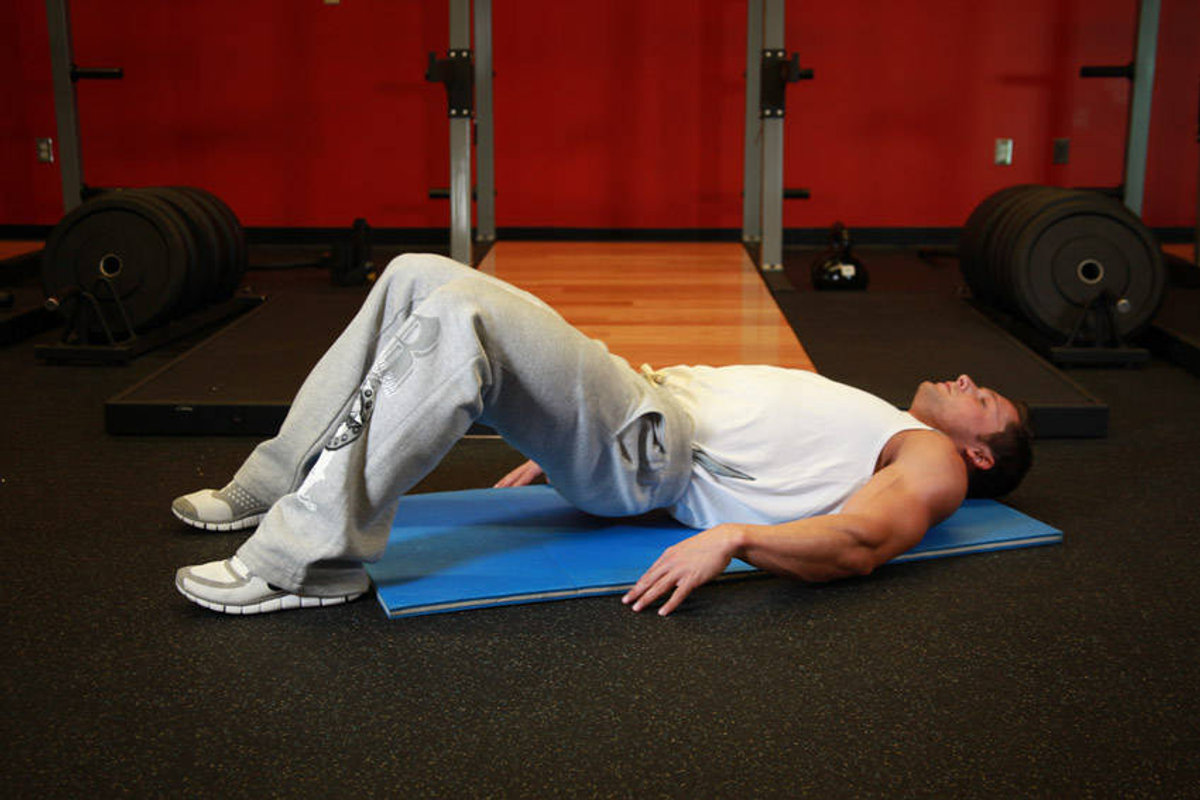
- Back on floor, knees bent, feet flat on the ground
- Push hips up until shoulders-hips-knees form a line
- Squeeze glutes at top for 2 seconds – lower under control
Common Mistakes
- Hyperextending the lumbar spine instead of maximally squeezing the glutes
- Heels lifting off the floor – shifts work to the hamstrings
- Moving too quickly without pausing at the top – reduces glute activation
- Feet positioned too far from the buttocks – more hamstring, less glute dominance
Modifications
Beginner
Position feet closer to the buttocks and extend the hold at the top to 3–5 seconds. Focus on glute squeeze – not height.
For Joint Issues
Exercise is safely performable with almost all joint problems. For knee issues: adjust foot position so no knee pain occurs. For back issues: don't hyperextend.
Advanced
Place weight (plate or dumbbell) on hips. Single-leg variation. Tempo: 3-second eccentric, 3-second pause at top.
Scientific Basis
Research explicitly lists glute bridges as safe for knee OA, patellofemoral pain, and spinal issues. Activates gluteus maximus without loading knee, shoulder, or back. Entry exercise for hip thrusts.
Contraindications
- Very few contraindications – this is one of the safest exercises available
- Acute severe back pain where any trunk movement causes pain
- Recent hip surgery without medical clearance
Related Exercises
Related Guides