
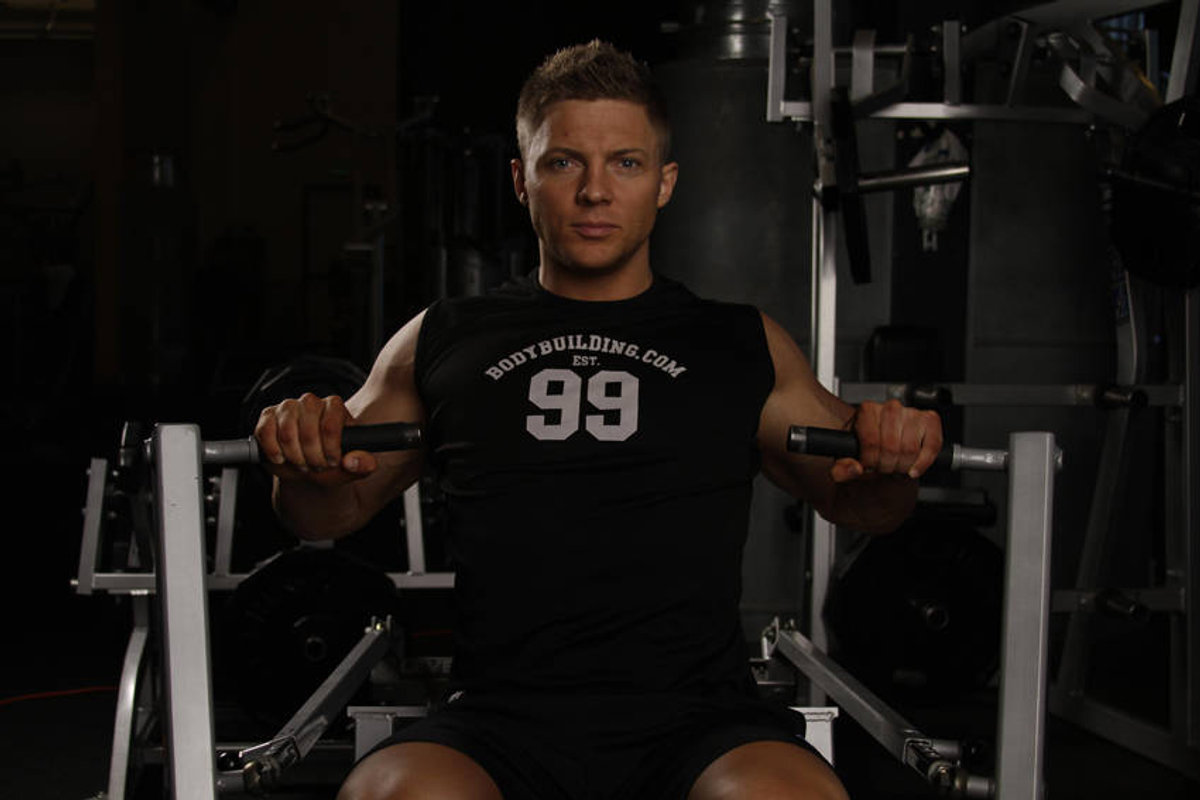
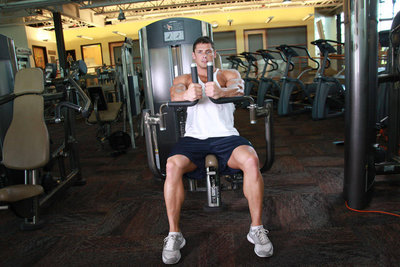
Machine Chest Press
Safety Rating for 40+
Benefits for 40+
The machine chest press is one of the most valuable exercises against age-related upper body sarcopenia, generating high mechanical tension with minimal joint wear. Fisher et al. (2024) showed in a meta-analysis of 17 studies that machine-based RT significantly improves functional capacity in older adults – with 90% fewer injuries than free weights (Kerr et al.). Especially after 40, when tendon elasticity and collagen turnover decline, the guided movement path provides safety without compromising muscle-building stimulus.
Form Cues
- Retract shoulder blades and press firmly into the pad
- Set handles at chest height, keep elbows above shoulder line
- Press and lower under control — no momentum
Common Mistakes
- Seat set too high or too low – handles should be exactly at chest height, otherwise the shoulder is overloaded
- Shoulder blades not retracted – without a solid scapular position, the anterior deltoid takes over, increasing impingement risk in 40+ trainees
- Letting the weight bounce at end position instead of controlling the eccentric – the lowering phase is especially important for tendon adaptation after 40
- Starting too heavy after a training break – after 40, tendons and ligaments need 4–6 weeks to adapt, even when muscles are ready sooner
Modifications
Beginner
Start with very light weight to learn correct seat position and scapular retraction. First 2 weeks only 2 sets of 12–15 reps at RPE 5–6.
For Joint Issues
For shoulder issues: limit range of motion – don't return to full stretch. Only open handles to maximum 90° elbow flexion. For wrist issues: press with open palms rather than tight gripping.
Advanced
Unilateral execution (one arm), pause reps (3 sec pause at stretched position), or slow tempo (4 sec eccentric) for additional hypertrophy stimulus.
Scientific Basis
Machine chest press offers an excellent stimulus-to-fatigue ratio with minimal injury risk. Fisher et al. (2024) demonstrated that machine-based RT effectively improves functional capacity while presenting significantly lower injury risk than free weights.
Contraindications
- Acute shoulder injury or active inflammation in the shoulder joint
- Recent pectoral or triceps tendon injury
- Significant pain (above 3/10) during the movement despite adjusting weight and range of motion
- Uncontrolled hypertension – avoid Valsalva maneuver during heavy sets
Related Exercises
Related Guides