
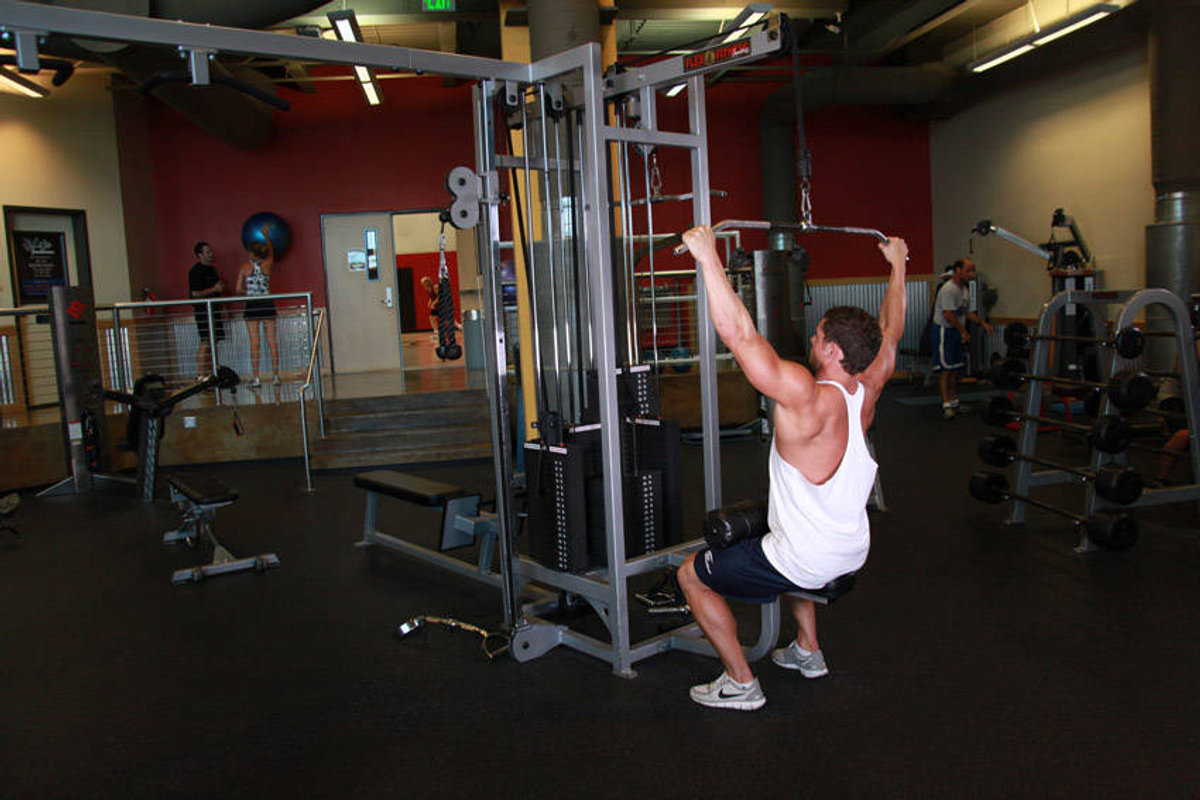
Wide-Grip Lat Pulldown (to Front)
Safety Rating for 40+
Benefits for 40+
The wide-grip lat pulldown is one of the most effective exercises against age-related postural deterioration and upper body sarcopenia. After 40, upper back muscle mass declines at an accelerated rate, leading to rounded shoulders and shoulder problems. The controlled cable path protects shoulder joints – especially important given the rotator cuff degeneration common after 40 – and allows precise autoregulation via RPE.
Form Cues
- Pull bar to upper chest – never behind the neck
- Draw shoulder blades down and back together
- Lean torso slightly back, return under control
Common Mistakes
- Pulling bar behind the neck – significantly increases shoulder impingement risk, especially with reduced shoulder mobility after 40
- Excessive leaning back and using momentum – loads the lumbar spine and reduces lat activation
- Grip too wide – exceeds individual shoulder mobility and causes joint pain
- Not fully extending elbows at the starting position – shortens range of motion and reduces training stimulus
Modifications
Beginner
Start with light weight and a narrower grip. Focus on scapular retraction before initiating the arm pull. 12–15 reps at RPE 6–7.
For Joint Issues
For shoulder issues, switch to shoulder-width or slightly narrower grip. Use a neutral-grip attachment to reduce shoulder external rotation. Limit range of motion to pain-free range.
Advanced
Pause reps with 2–3 second hold at the bottom. Drop sets on cable machine for mechanical overload. 1.5 reps (full pull, half return, full pull again) for intensified lat contraction.
Scientific Basis
Lat pulldown to front is a Tier 1 exercise with high SFR. The research explicitly warns against behind-the-neck variants due to shoulder impingement risk. Wide grip emphasizes the latissimus in its full width.
Contraindications
- Acute shoulder impingement or active rotator cuff inflammation
- Unstable shoulder joints (recurrent dislocations or subluxations)
- Acute cervical spine issues or herniated disc in the cervical region
- Stop immediately if pain exceeds 4/10 during the movement
Related Exercises
Related Guides