
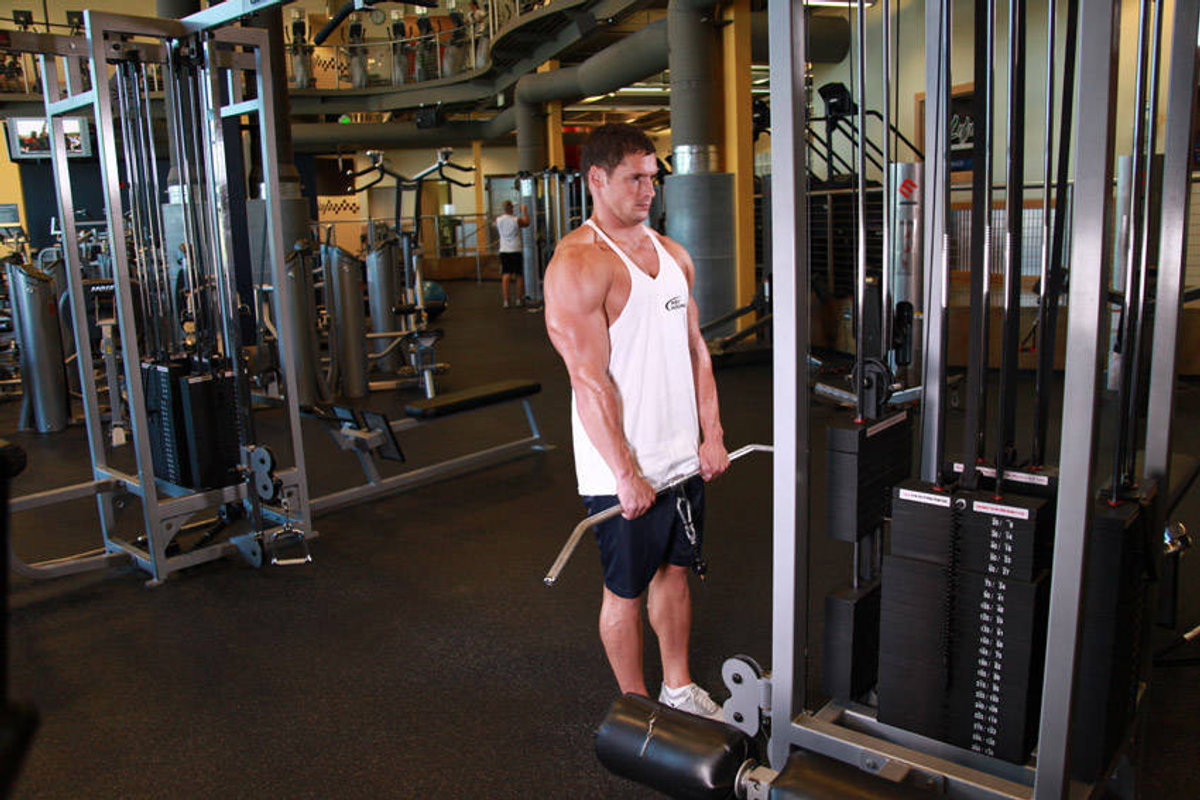
Cable Shrug
Safety Rating for 40+
Benefits for 40+
Cable shrugs offer the decisive advantage over dumbbell shrugs of constant tension throughout the full ROM – especially the eccentric phase under consistent load promotes tendon adaptation, particularly important given the slowed collagen synthesis after 40. The cable machine also enables finer weight increments for more precise progressive overload – an advantage given the conservative progression recommended for 40+.
Form Cues
- Cable from below, grip bar or rope attachment
- Shrug shoulders straight up – hold under control
- Lower slowly and allow the stretch in the trapezius
Common Mistakes
- Lowering weight too quickly – wastes the valuable eccentric phase for tendon adaptation
- Rolling shoulders instead of pulling straight up – loads AC joint and rotator cuff
- Standing too far from the cable – unfavorably changes resistance vector and loads lower back
- Bending arms and engaging biceps – reduces trap isolation
Modifications
Beginner
Rope attachment for more natural grip position. Light weight focusing on 2 second hold at top and 3 second controlled lowering. 12–15 reps.
For Joint Issues
For back issues: cable shrugs are already one of the safest exercises. Stand close to the cable to minimize the lever arm. For cervical issues: reduce weight and consciously keep head neutral.
Advanced
Single-arm cable shrugs for increased ROM and anti-lateral flexion work. Behind-the-back cable shrugs for altered pull angle. Drop sets on cable machine for maximum metabolic fatigue.
Scientific Basis
Constant cable resistance throughout full ROM – unlike dumbbells where tension drops at the top. Especially effective for controlled eccentric phases that promote tendon adaptation in 40+.
Contraindications
- Acute cervical spine issues or cervical syndrome
- Severe AC joint arthritis
- Thoracic outlet syndrome
- Acute inflammation in the shoulder or neck area
Related Exercises
Related Guide