
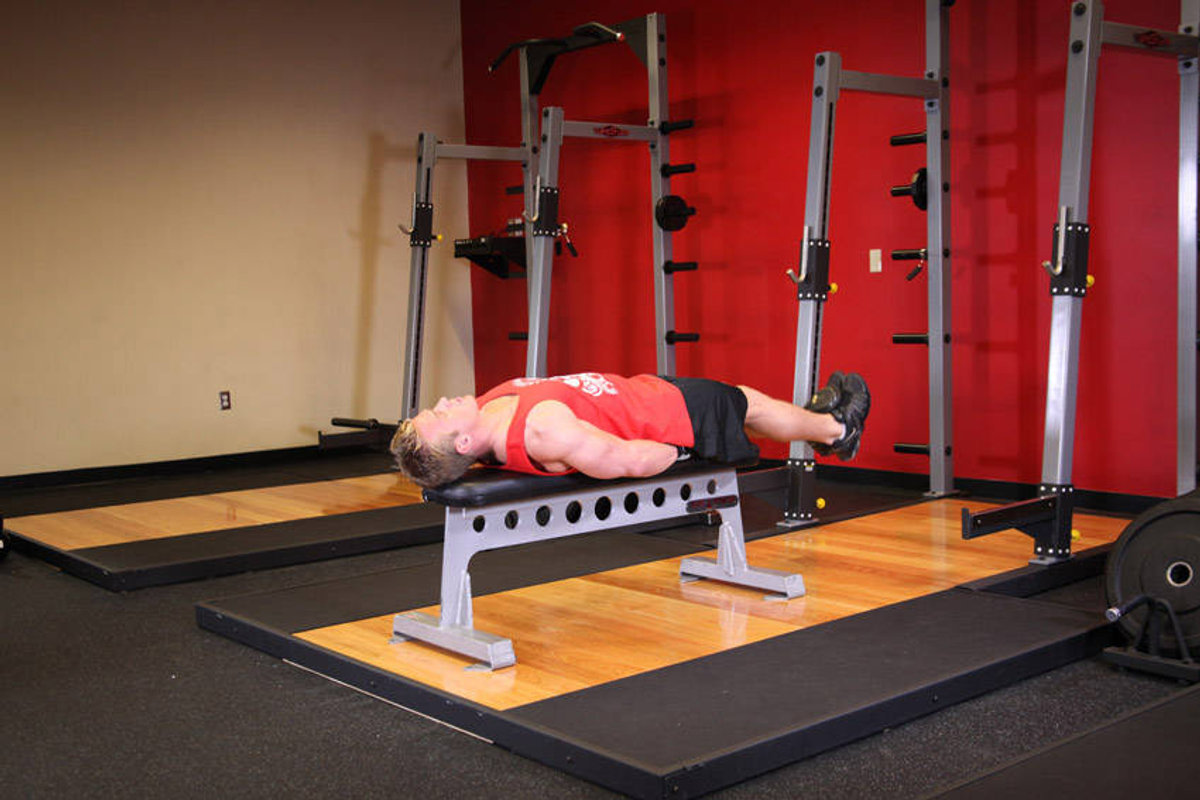
Lying Leg Raise
Safety Rating for 40+
Benefits for 40+
The lying leg raise is the shoulder-friendly alternative to the hanging leg raise and therefore the better choice for the majority of 40+ trainees. The bench provides tactile feedback for lumbar position – similar to the dead bug – and completely eliminates grip strength and shoulder demands. For 40+ with shoulder issues incompatible with the impingement risk of hanging, this is the only safe leg raise variation. The exercise simultaneously trains the hip flexors, whose shortening after 40 from prolonged sitting is among the most common causes of lumbar complaints.
Form Cues
- Lie flat on bench, hold sides of bench with hands
- Raise straight legs under control to approximately 90° hip flexion
- Lower back stays on the bench – reduce ROM if lower back arches
Common Mistakes
- Letting lower back lift off the bench – the most common problem in 40+ with weak deep trunk muscles, directly leading to lumbar overload
- Dropping legs instead of lowering with control – the eccentric phase is at least equally important for training effect
- Choosing too large a ROM before trunk strength is sufficient – better to do only 45° hip flexion with perfect lumbar control
- Lifting head and tensing neck – creates unnecessary neck tension, especially in 40+ with cervical spine issues
Modifications
Beginner
Raise with bent knees instead of straight legs (shorter lever, lower core demand). Use only a short ROM range and gradually extend.
For Joint Issues
For back issues: significantly reduce ROM until the lower back stays securely on the bench. Bend knees to shorten the lever. For hip flexor issues: limit ROM to pain-free range.
Advanced
Ankle weights, hold a ball between feet, or slow eccentric tempo (5 seconds lowering). Progress to hanging leg raise when strength is sufficient.
Scientific Basis
Regression variant of the hanging leg raise – the bench provides back feedback and unloads the shoulders. Primarily trains hip flexion with trunk stabilization. Caution: with insufficient core strength the pelvis tilts and the lumbar spine arches.
Contraindications
- Acute disc herniation with pain during hip flexion
- Acute iliopsoas tendinitis or hip flexor inflammation
- Severe diastasis recti without therapeutic guidance – intra-abdominal pressure may worsen the separation
- Uncontrollable lumbar hyperextension despite bent knees and reduced ROM
Related Exercises

Related Guide