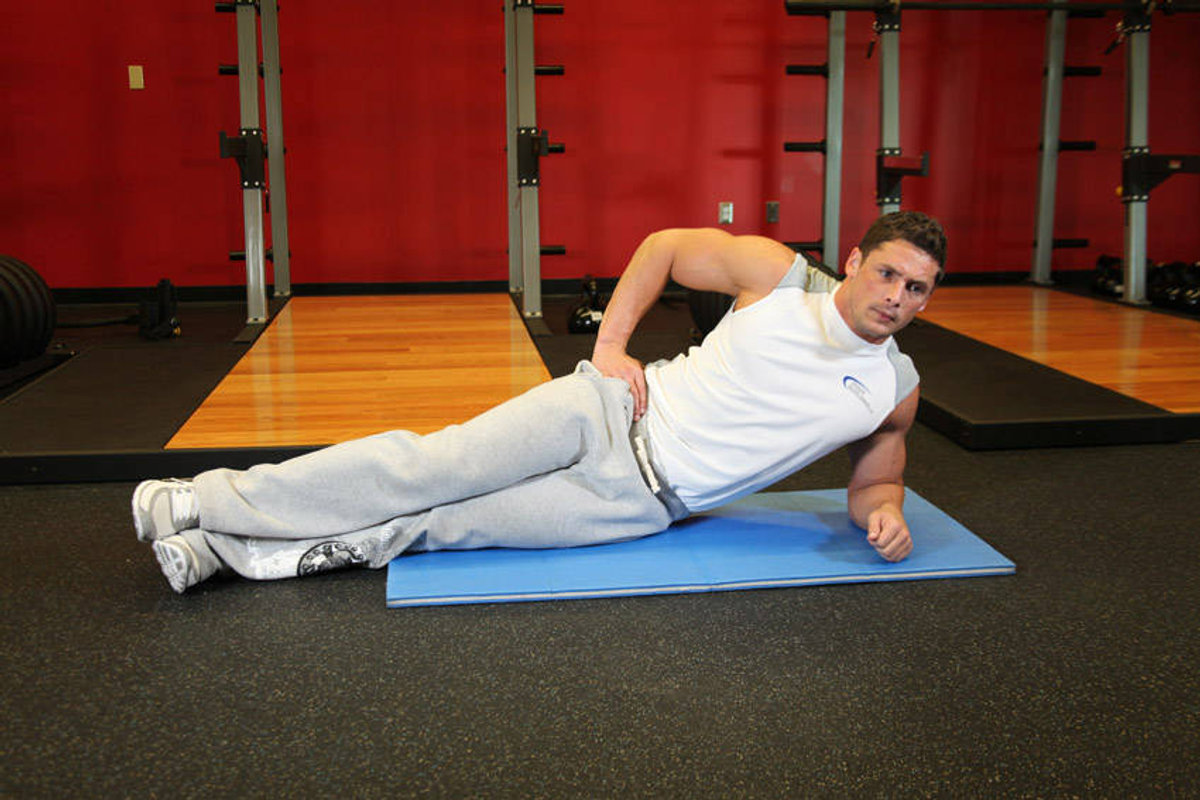
Side Bridge (Side Plank)
Safety Rating for 40+
Benefits for 40+
The side bridge is part of McGill's Big 3 and specifically trains anti-lateral flexion – the ability to resist lateral spinal tilting. The quadratus lumborum and oblique muscles progressively lose strength after 40, leading to asymmetric trunk stability and increased fall risk. Simultaneously, the exercise strengthens the hip abductors, which research shows contribute to patellofemoral pain reduction. For 40+ adults with early osteoporosis, the side bridge is particularly relevant as it loads the lateral trunk chain, which is often neglected in daily life.
Form Cues
- Support sideways on forearm, elbow below shoulder
- Lift hips until body forms a straight line
- Don't let top hip rotate forward or back – keep pelvis neutral
Common Mistakes
- Rotating hips forward or backward instead of keeping pelvis neutral – significantly reduces the anti-lateral flexion effect
- Letting hips sag – common in 40+ with weaker lateral trunk muscles; better to do shorter holds with correct hip position
- Supporting on hand instead of forearm – increases shoulder stress and is risky for 40+ with impingement tendencies
- Letting head drop or tilting into neck – disrupts spinal alignment and can trigger neck tension
Modifications
Beginner
Bend knees and support on the floor to shorten the lever. Alternatively, lean against a wall to reduce the load.
For Joint Issues
For shoulder issues: position elbow further from the body or perform standing against a wall. For hip issues: place top leg slightly in front of bottom leg for better stability.
Advanced
Raise top leg (star side plank), lower and raise hips (side bridge dips), or wear a weighted vest. Copenhagen variation with top leg on a bench for adductor activation.
Scientific Basis
McGill Big 3 – Part 2: Anti-lateral-flexion exercise training the quadratus lumborum and lateral trunk stabilizers without loading the spine. McGill's research: essential for spinal stability and back health.
Contraindications
- Active shoulder instability or recent shoulder surgery
- Acute lateral trunk pain or rib injuries
- Uncontrolled hypertension – isometric loading raises blood pressure
- Advanced wrist arthritis (for hand-supported variation)
Related Exercises
Related Guide