
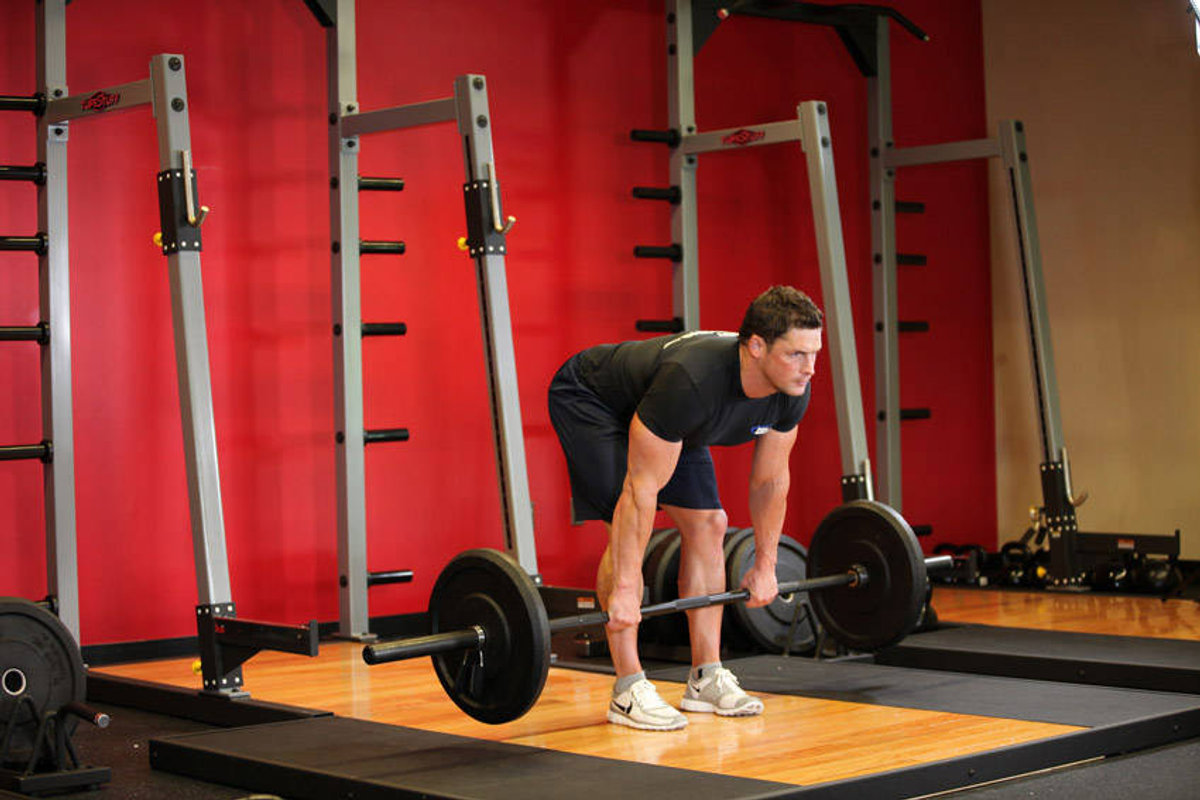
Stiff-Legged Barbell Deadlift
Safety Rating for 40+
Benefits for 40+
The barbell version allows heavier loads than dumbbells and is therefore more effective for advanced hamstring development. For over-40 trainees with solid hinge technique, it provides a progressive overload stimulus that counters age-related sarcopenia in the posterior chain. The eccentric hamstring loading promotes tendon health – Beyer et al. (2015) showed eccentric training to be effective for tendinopathy.
Form Cues
- Guide bar close to the body, legs nearly straight (slight knee bend)
- Neutral back is non-negotiable – stop immediately if back rounds
- Only as deep as hamstring flexibility allows
Common Mistakes
- Back rounding – the non-negotiable red line, stop immediately and reduce weight
- Excessive lordosis (hyperextension) as overcompensation – stresses facet joints
- Bar guided far from the body – extreme lever arm on the lumbar spine
- No awareness of hamstring stretch limit – often shortened hamstrings in over-40s
Modifications
Beginner
Not recommended as an entry exercise – first master dumbbell version or cable pull-through. Only transition to barbell after demonstrating reliable hinge technique with neutral back.
For Joint Issues
For back issues: switch to dumbbell version or cable pull-through. For wrist problems: use lifting straps. Strictly limit range of motion to pain-free range.
Advanced
Deficit stiff-legged deadlift (standing on a platform) for extended range of motion. Tempo: 4-second eccentric for maximum tendon adaptation.
Scientific Basis
Barbell allows heavier loads than dumbbells for advanced hamstring development. Tier 2 due to increased demands on lumbar stability under load. Complements the RDL (in Back batch) with a slightly different tension profile.
Contraindications
- Acute or chronic herniated disc
- Spinal stenosis with neurological symptoms
- Inability to maintain a neutral back under load
- Acute sciatica
Related Exercises
Related Guide