
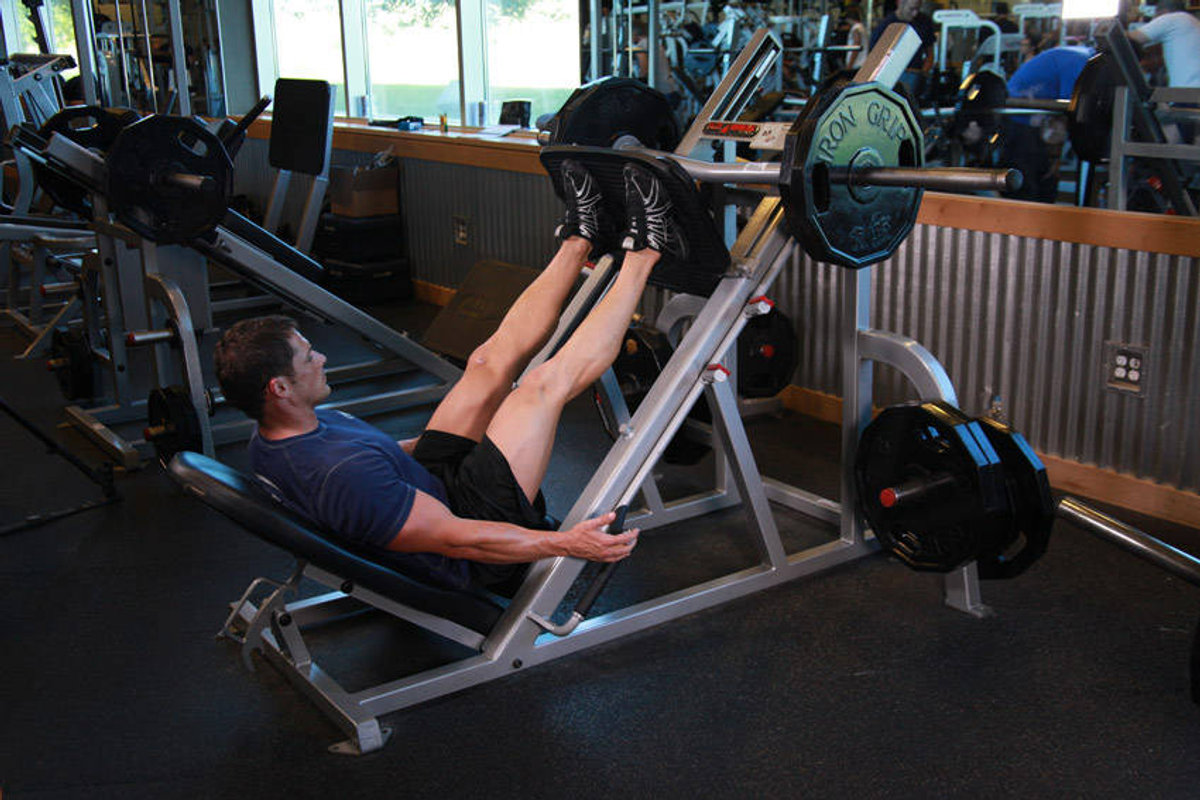
Leg Press
Safety Rating for 40+
Benefits for 40+
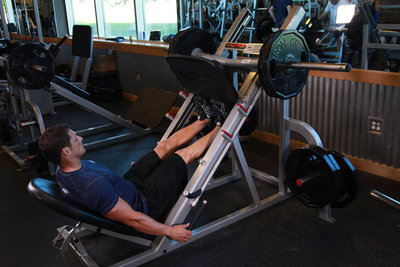
The leg press is one of the most effective exercises for those over 40, enabling high leg loading without spinal compression – a decisive advantage with age-related disc degeneration or back issues. The guided path eliminates trunk stability demands, allowing the leg muscles to be trained to fatigue in isolation. Meta-analyses show machine-based resistance training effectively improves functional capacity in older adults with significantly lower injury risk than free-weight training (Fisher et al., 2024).
Form Cues
- Press back fully into the pad – lower back must NOT lift off
- Feet shoulder-width on platform, don't bend knees past 90°
- Don't fully lock out knees – maintain slight bend at top
Common Mistakes
- Lower back lifts off the pad – caused by lowering too deep and can stress discs, especially in over-40s with degenerative changes
- Knees fully locked out (hyperextension) – dangerous for knee joints, particularly with declining cartilage quality
- Too heavy weight with shortened range of motion – reduces training stimulus and compensates through momentum instead of muscle force
- Feet positioned too low on the platform, unnecessarily increasing knee shear forces
Modifications
Beginner
Start with light weight and test foot position: feet mid to high on the platform for less knee stress. Initially limit range of motion to 45–90° knee flexion.
For Joint Issues
For knee issues: position feet higher on the platform (more glute/hamstring focus, less knee angle). Limit range of motion to pain-free 45–90°. For back issues: never allow the lower back to lift off the pad.
Advanced
Single-leg press for asymmetry correction. Drop sets or rest-pause sets for intensified hypertrophy. Vary foot position for targeted muscle emphasis.
Scientific Basis
Leg press is a Tier 1 exercise with high SFR per research. Eliminates trunk stability demands and allows high leg loading without spinal compression. Foot position varies focus: high = more glutes/hamstrings, low = more quadriceps.
Contraindications
- Acute herniated disc – axial compression possible with poor positioning
- Acute knee joint inflammation or recent knee surgery without medical clearance
- Severe knee OA with pain above 5/10 despite modification
- Uncontrolled hypertension – the leg press can significantly raise blood pressure through the Valsalva maneuver
Related Exercises
Related Guides