
Bodyweight Squat
Safety Rating for 40+
Benefits for 40+
The bodyweight squat directly replicates the sit-to-stand movement pattern essential for daily independence – a capacity that must be actively maintained from 40 onward. Without external load, joints and tendons can be gently accustomed to squatting movements, which is especially valuable after extended training breaks or in early stages of osteoarthritis. Regular bodyweight squats preserve ankle and hip mobility, whose decline with age is a primary risk factor for falls.
Form Cues
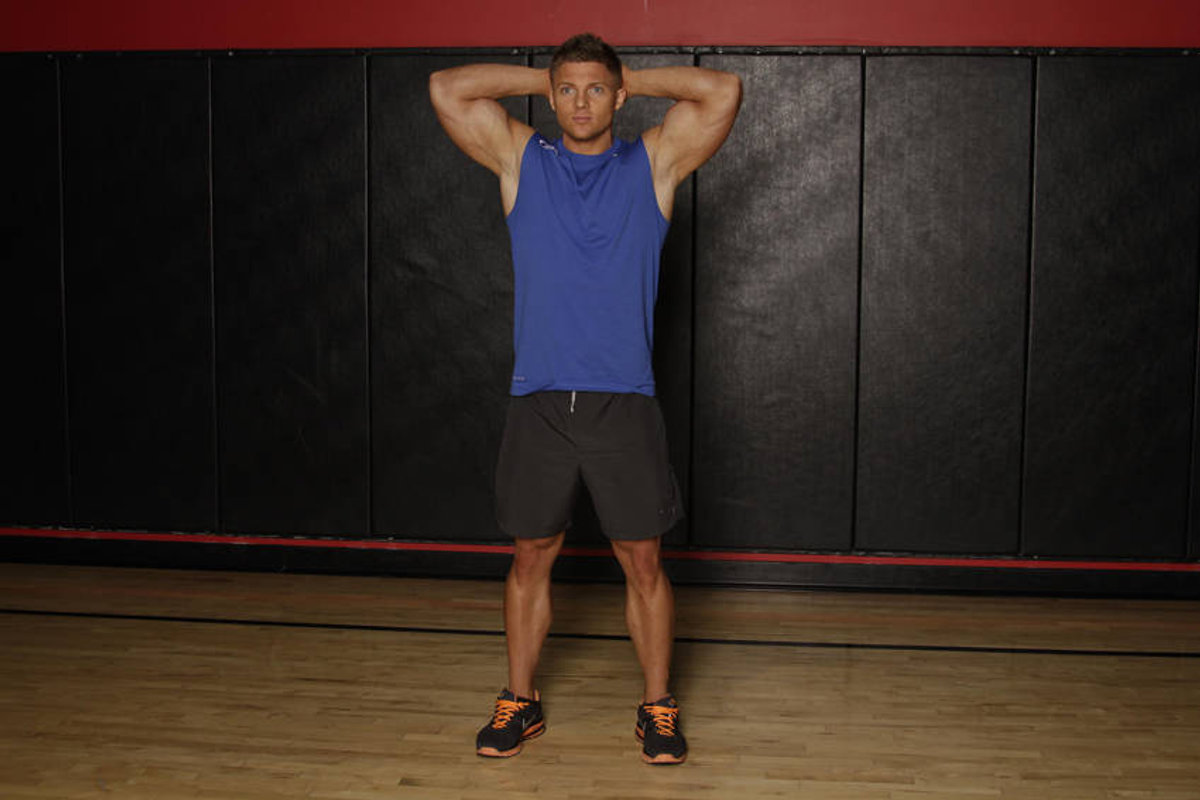
- Feet shoulder-width, toes slightly pointed out
- Push hips back and down as if sitting into a chair
- Drive knees over toes, keep torso upright
Common Mistakes
- Torso tips too far forward – often caused by restricted ankle mobility that becomes more common after 40
- Knees collapse inward during the upward phase – a sign of gluteus medius weakness
- Insufficient depth due to fear of knee pain, even though pain-free depth strengthens the joints
- Bouncing at the bottom instead of a controlled reversal
Modifications
Beginner
Hold onto a stable object (TRX, door frame, chair) for additional balance. Sit onto a box or chair and stand back up (sit-to-stand).
For Joint Issues
For knee issues: limit range of motion to 45–60°, use wall sits as an isometric alternative. For hip issues: wider stance and slightly externally rotated feet for more space in the hip joint.
Advanced
Single-leg variation (pistol squat progression), tempo squats with 5-second eccentric, or pause squats with 3-second hold at the bottom.
Scientific Basis
Fundamental movement pattern directly mapping to daily functionality (sit-to-stand). Perfect as warm-up, technique training, or entry point for absolute beginners. No equipment needed – can be performed anywhere.
Contraindications
- Acute knee or hip joint inflammation with swelling
- Shortly after knee or hip surgery without medical clearance
- Severe balance disorders without support available – fall risk
Related Exercises
Related Guide