
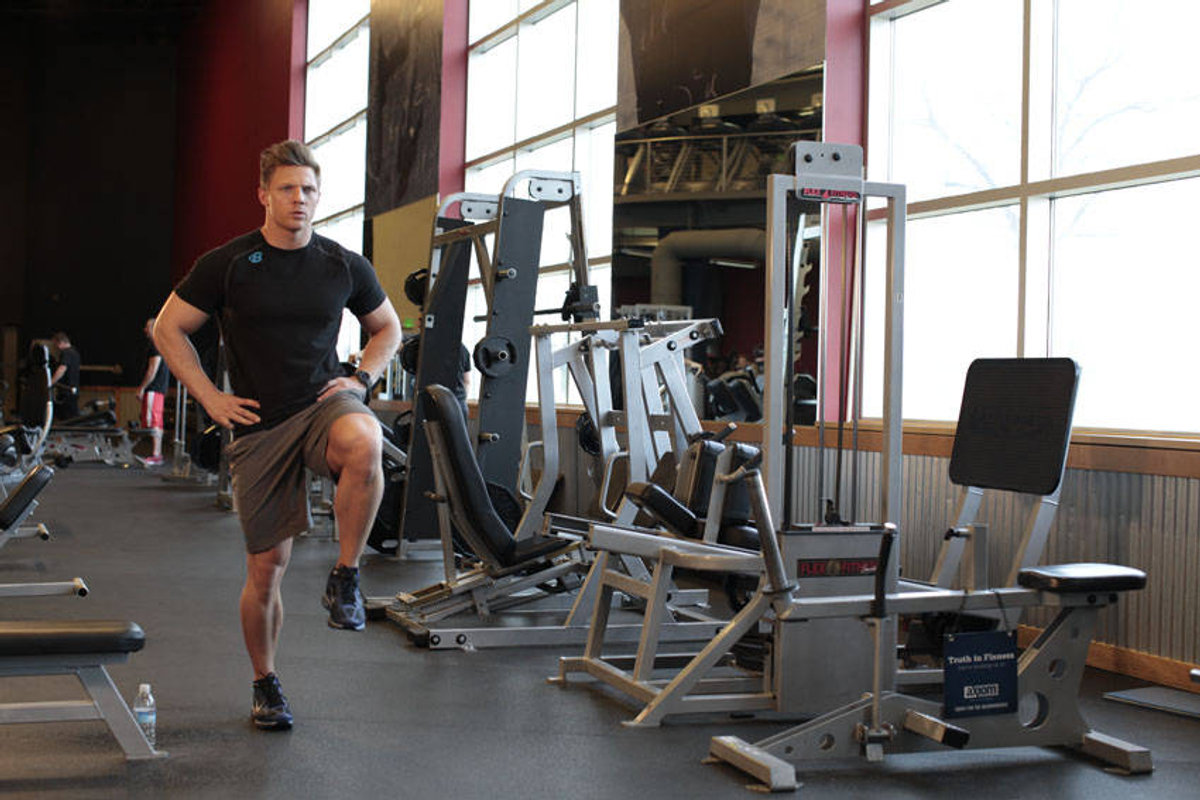
Bodyweight Walking Lunge
Safety Rating for 40+
Benefits for 40+
Walking lunges represent the highest balance demand of all lunge variations and train gait dynamics – a skill that becomes increasingly important after 40, as gait disturbances are an early indicator of functional decline. As a bodyweight exercise, they are joint-friendly and functionally replicate daily movement patterns like walking and direction changes. The dynamic stabilization strengthens deep leg musculature and the neuromuscular system.
Form Cues
- Alternating large steps forward, rear knee toward floor
- Look ahead, torso upright – don't lean forward
- If balance is challenging: shorter steps or along a wall
Common Mistakes
- Too fast a pace compromising balance – especially risky for over-40s due to increased fall risk
- Too narrow stance (feet on a single line) instead of shoulder-width track – reduces stability
- Torso sways laterally – sign of weak hip stabilizers
- Knee caves inward during the upward phase
Modifications
Beginner
Walk along a wall or railing for safety. Shorten stride length. Alternatively: static split squats as a preliminary step.
For Joint Issues
For knee issues: switch to reverse walking lunges (more knee-friendly). Adjust stride length and don't lower rear knee to the floor. For balance issues: use walking sticks or a handrail.
Advanced
Dumbbells in hands for additional resistance. Walking lunges with torso rotation for core activation. Tempo variation: 3-second eccentric per step.
Scientific Basis
Dynamic lunge pattern with highest balance demand. Tier 2 due to the dynamic stabilization component. Bodyweight as entry before loaded variations. Trains gait dynamics and functional leg coordination.
Contraindications
- Severe balance disorders without a safe environment
- Acute knee or hip joint inflammation
- Acute dizziness or vertigo
Related Exercises
Related Guide