
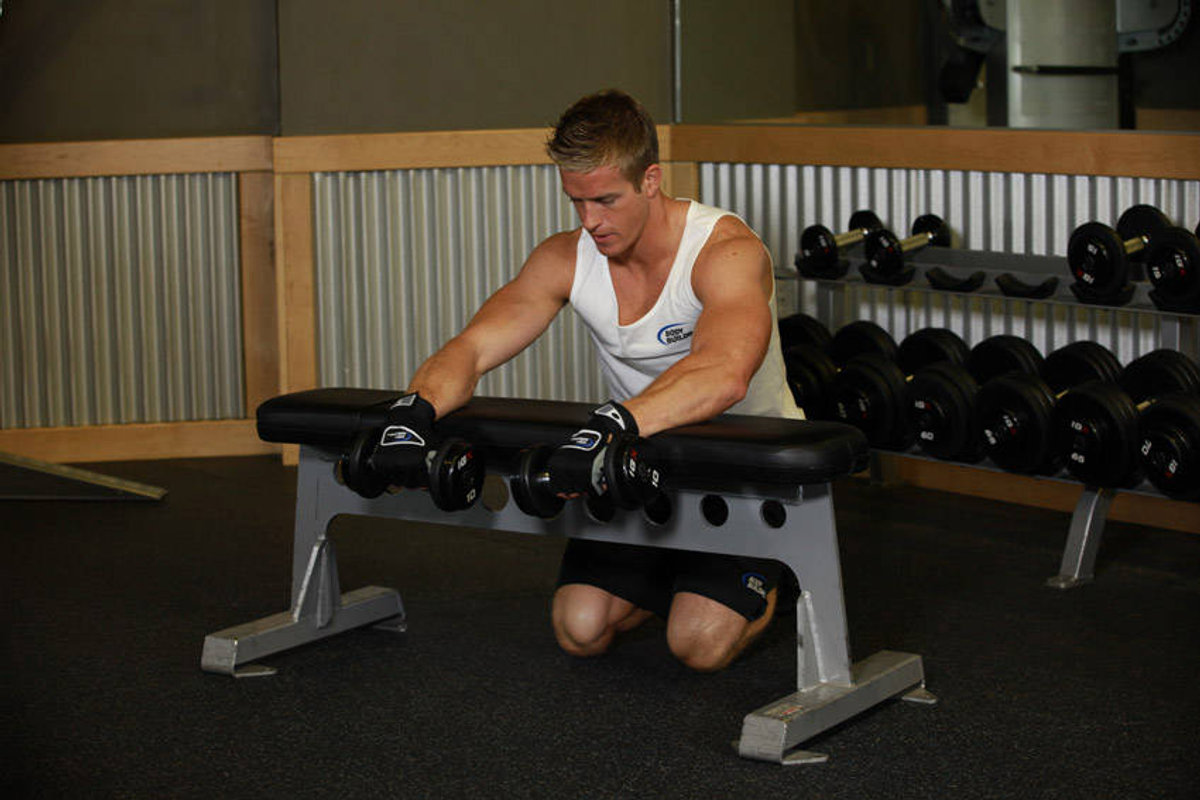
Dumbbell Wrist Curl (Palms Down)
Safety Rating for 40+
Benefits for 40+
Targeted strengthening of the wrist extensors is the most direct prevention against lateral epicondylitis (tennis elbow) – one of the most common overuse complaints after 40. The balance between flexors and extensors is crucial, as tendon degeneration with age converts imbalances into overuse injuries faster. Eccentric extensor work is specifically used in physiotherapy for treating epicondylitis – this exercise serves as both prevention and potential rehabilitation.
Form Cues
- Forearms on bench/thigh, palms facing down
- Extend wrists upward (extension) – smaller ROM than flexion
- Even lighter weights than palms-up – extensors are weaker
Common Mistakes
- Using same weight as palms-up – extensors are significantly weaker, overloading is inevitable
- Forearms lifting off the support – transforms targeted isolation into a forearm curl variant
- Too fast tempo – the sensitive extensor tendons require particularly slow, controlled loading
- Skipping in favor of palms-up curls – the extensors are the critical weak point especially for 40+
Modifications
Beginner
Start with just 0.5–1 kg or even without weight. 20–25 reps, focus on controlled extension. The extensors are significantly weaker than the flexors.
For Joint Issues
For lateral epicondylitis: eccentric-emphasized execution (slow lowering, brief hold, faster raising) – this corresponds to the physiotherapeutic protocol. Limit ROM to pain-free range.
Advanced
Eccentric overload: lift with both hands, lower with one hand in 5 seconds. Or: combination with reverse cable curls as extensor superset.
Scientific Basis
Trains the wrist extensors (outer forearm) – balance between flexors and extensors prevents epicondylitis (tennis elbow). Especially relevant for 40+ where repetitive stress and tendon degeneration increase risk.
Contraindications
- Acute lateral epicondylitis in the inflammatory phase – only use as rehabilitation exercise after acute inflammation subsides
- Acute tendon sheath inflammation of wrist extensors – loading worsens the inflammation
- De Quervain's syndrome – extension under load stresses the thumb tendons
- Recent wrist fracture – no loading until complete consolidation
Related Exercises
Related Guide