
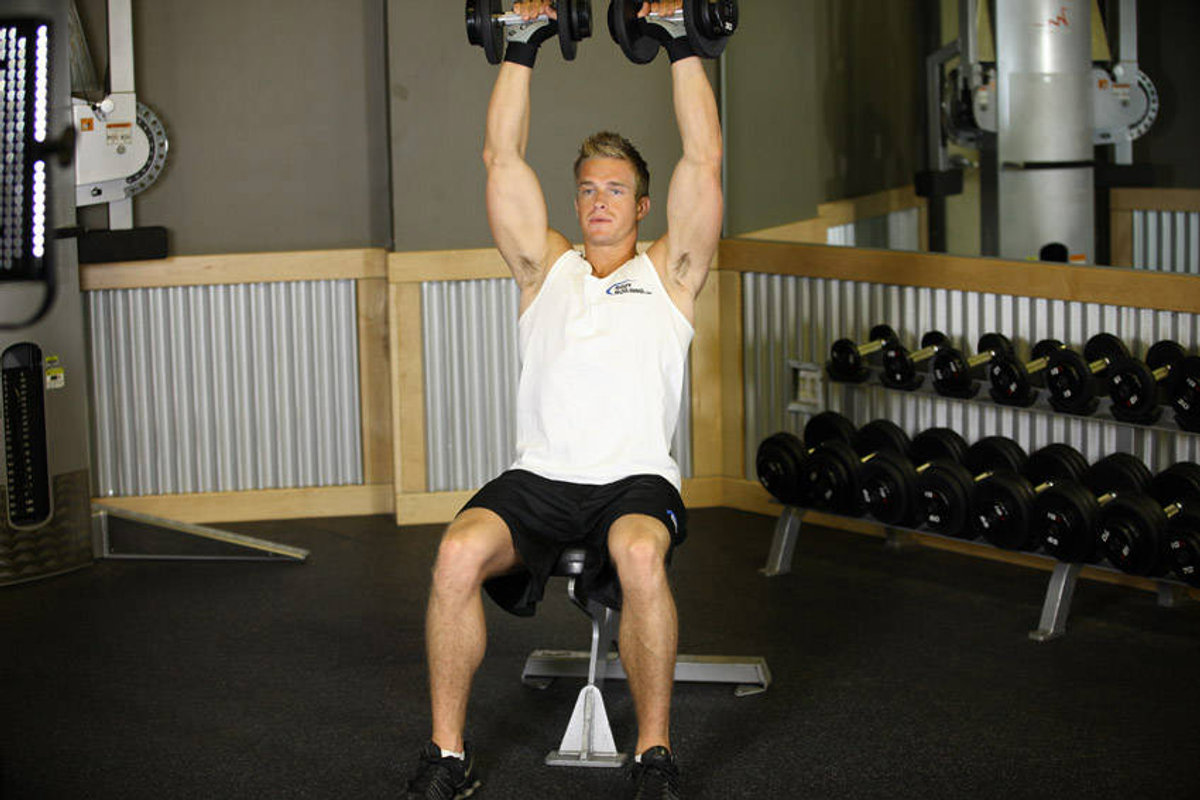
Seated Dumbbell Shoulder Press
Safety Rating for 40+
Benefits for 40+
Seated dumbbell press is one of the most effective exercises against age-related shoulder muscle weakness and deltoid sarcopenia. Independent arm movement corrects side-to-side imbalances that accumulate over decades of asymmetric loading. Back support reduces lumbar spine stress – especially valuable given the degenerative disc changes more common after 40.
Form Cues
- Press back firmly into the seat pad, maintain slight arch
- Start dumbbells at ear level, elbows below wrists
- Don't fully lock out overhead – stop just before lockout
Common Mistakes
- Choosing weights too heavy and compensating with torso momentum – significantly increases impingement risk in 40+
- Fully locking out arms overhead – creates subacromial compression that can trigger pain with age-related narrowing
- Elbows flaring too far out instead of staying under wrists – overloads the rotator cuff
- Lifting back off the seat pad on heavy reps – shifts load to the lumbar spine
Modifications
Beginner
Start with light dumbbells (3–5 kg), use half range of motion (ear level to 45° overhead). Alternatively: perform single-arm to reduce stabilization demands.
For Joint Issues
For shoulder impingement: limit range of motion to below 90° abduction and press with neutral grip (palms facing each other). Alternatively switch to landmine press or machine shoulder press.
Advanced
Tempo variation 3-1-2 (3 sec eccentric, 1 sec pause, 2 sec concentric) for greater muscle stimulus with less joint stress. Alternatively: 1.5-reps (full rep + half rep = 1 rep).
Scientific Basis
The research explicitly lists seated dumbbell shoulder press as a Tier 1 exercise. Independent arm movement allows a natural, shoulder-friendly pressing path. Seated position stabilizes the lumbar spine and reduces stability demands.
Contraindications
- Acute shoulder impingement symptoms or active rotator cuff inflammation
- Unstable shoulder (history of dislocation or post-surgery without medical clearance)
- Acute disc issues in the cervical or thoracic spine
- Significant overhead mobility restriction (flexion below 150°)
Related Exercises
Related Guide