
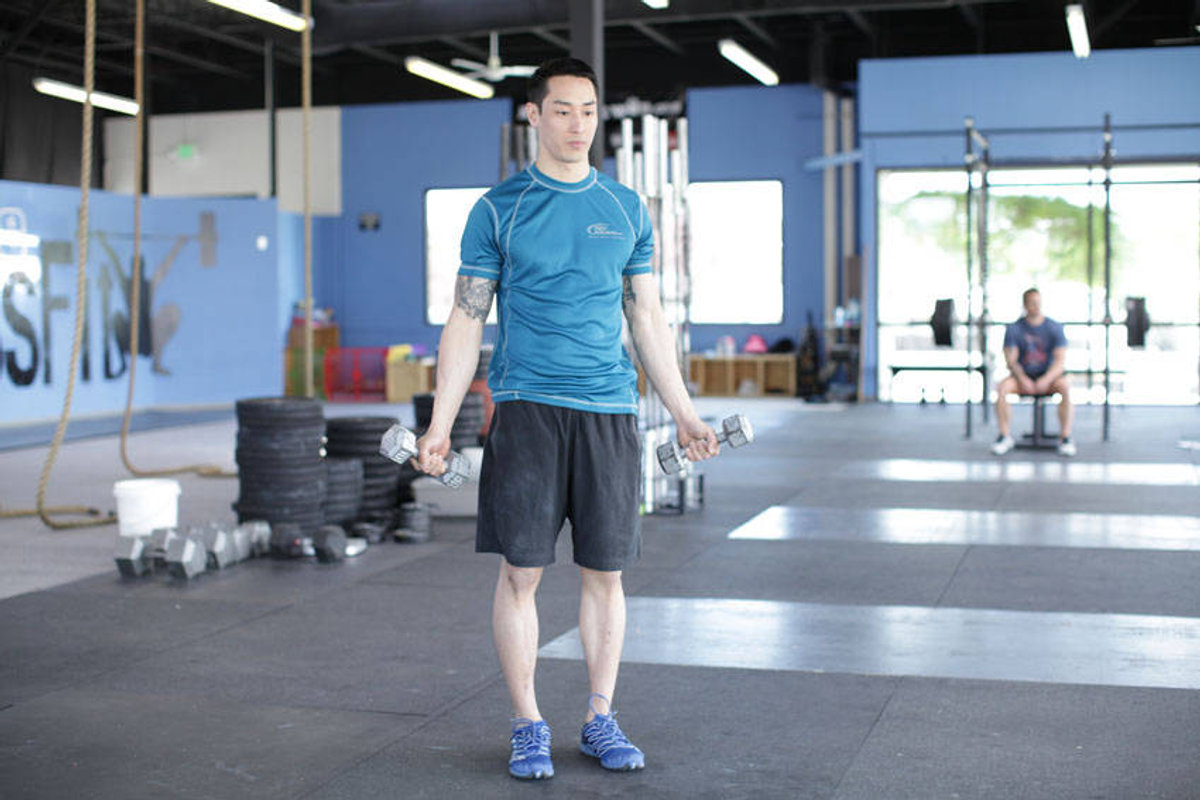
Dumbbell Scaption
Safety Rating for 40+
Benefits for 40+
Scaption is the biomechanically safest raising movement for the shoulder and has therapeutic rehabilitation value – both highly relevant for 40+. Movement in the natural scapular plane (30° forward from lateral) significantly reduces subacromial impingement risk compared to strict lateral raises. For trainees with the shoulder stiffness or early impingement common after 40, this is often the only pain-free raising movement available.
Form Cues
- Raise arms approximately 30° in front of the lateral plane (scapular plane)
- Thumbs point slightly upward – shoulder blades stable
- Raise to shoulder height, lower under control
Common Mistakes
- Raising in the strictly lateral plane instead of 30° forward – then it's regular lateral raises without the safety advantage
- Turning thumbs downward – narrows subacromial space and increases impingement risk
- Raising above shoulder height – even in the scapular plane, stress increases above 90°
- Tempo too fast – the therapeutic quality requires controlled, deliberate movements
Modifications
Beginner
Start with very light weights (1–3 kg) or no weight at all. Practice in front of a mirror to correctly gauge the 30° position.
For Joint Issues
Scaption is already the most joint-friendly variant. If pain still occurs: limit ROM to 60° and use slow tempo (4 sec up, 4 sec down). Emphasize thumbs-up position.
Advanced
Add isometric hold for 3–5 seconds at shoulder height. Or: light weights with very high volume (3–4 sets × 20 reps) as rehabilitation protocol.
Scientific Basis
Scaption raises in the natural plane of the scapula – biomechanically the safest raising movement. Reduces subacromial impingement risk compared to strict lateral raises. Therapeutic value in shoulder rehabilitation.
Contraindications
- Acute frozen shoulder (adhesive capsulitis) – any elevation can worsen inflammation
- Recent rotator cuff surgery without clearance for abduction movements
- Severe shoulder instability – even the safe scapular plane can be problematic with instability
Related Exercises
Related Guide