
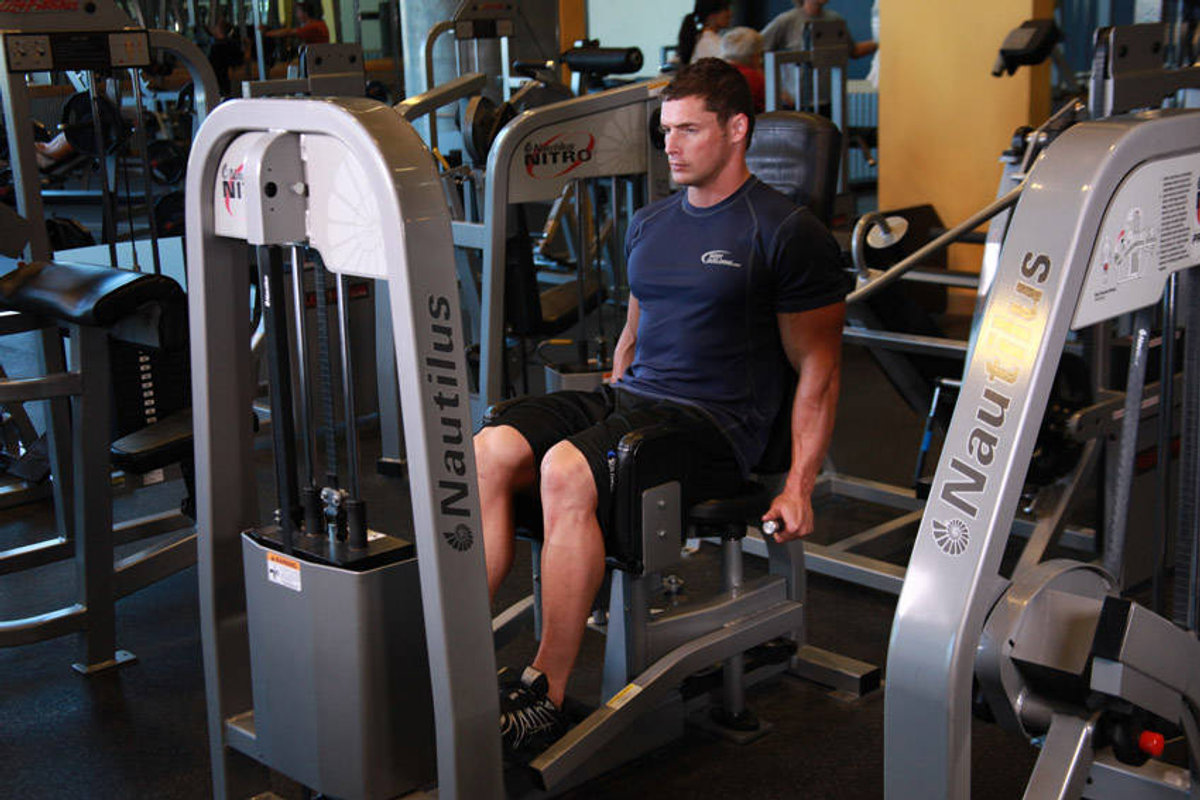
Hip Abductor Machine
Safety Rating for 40+
Benefits for 40+
Hip abductors and external rotators showed superior pain reduction for patellofemoral pain when added to quadriceps training according to research (Nakagawa et al.; Fukuda et al.). After 40, hip abductor strength is critical for knee stability during walking and stair climbing. Weak abductors lead to medial knee collapse (valgus) that promotes injuries during squats and lunges – a problem that becomes more common with increasing age.
Form Cues
- Upright seat, back against pad, legs on pads
- Push legs outward under control – hold 1 sec at widest point
- Bring together slowly – don't let them snap back
Common Mistakes
- Torso leans to the opposite side to move more weight – compensates for hip abduction
- Forcing too large an end position (ROM) that causes pain
- Too fast return – legs snap back together uncontrolled
- Back comes away from the pad
Modifications
Beginner
Light weight, full control, focus on gluteus medius activation at the widest point.
For Joint Issues
For hip issues: limit ROM to pain-free range. For knee issues: this exercise is generally knee-friendly and is even recommended for knee rehabilitation.
Advanced
Pause reps with 3-second hold at the widest point. Band walks or side-lying hip abduction as functional supplements. Drop sets for volume accumulation.
Scientific Basis
Hip abductors and external rotators showed superior pain reduction for patellofemoral pain when added to quadriceps training per research (Nakagawa et al.; Fukuda et al.). Essential for hip stability and knee protection in 40+.
Contraindications
- Acute hip osteoarthritis with pain during abduction
- Acute trochanteric bursitis
- Recent hip surgery without medical clearance
Related Exercises
Related Guide