
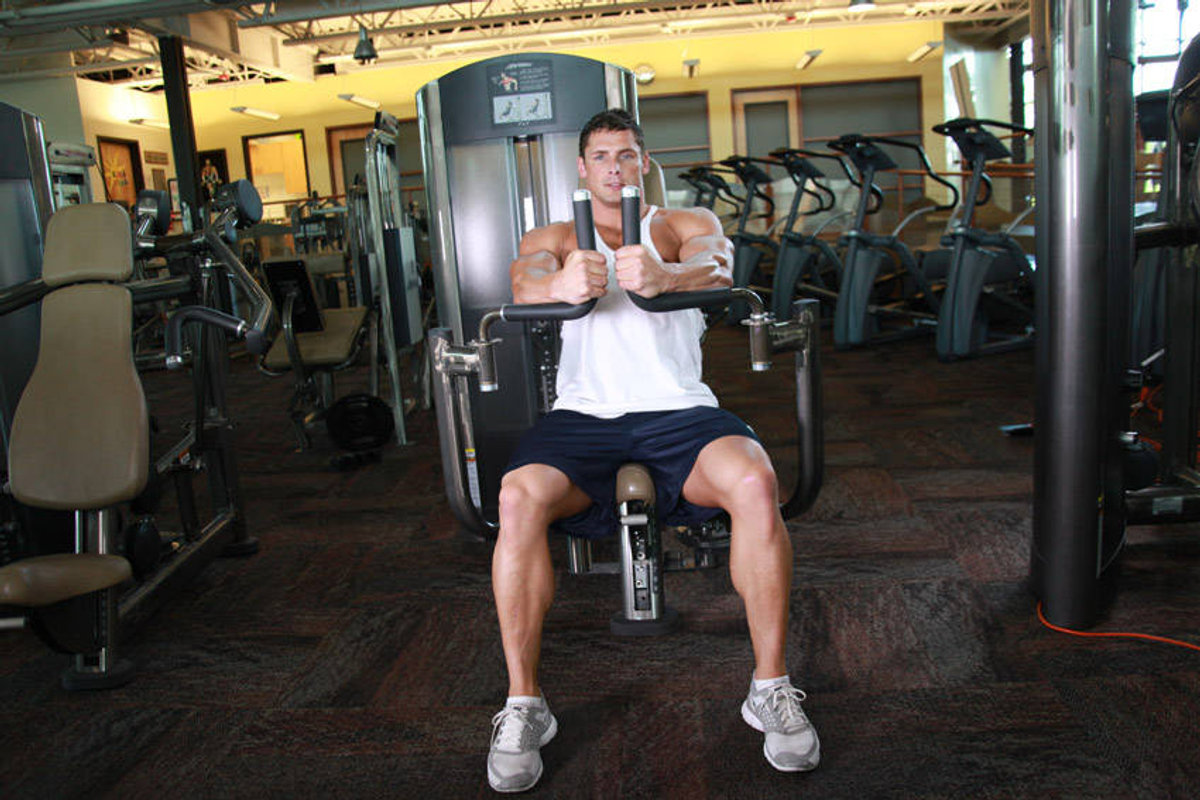
Pec Deck / Butterfly Machine
Safety Rating for 40+
Benefits for 40+
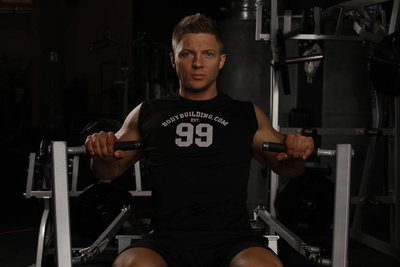
The butterfly machine is one of the safest methods for chest volume accumulation after 40 – the guided path eliminates stabilization demands and allows safe training to failure. Grgic et al. (2021) showed that for isolation exercises, training near failure (RPE 8–10) produces maximum hypertrophy with minimal overtraining risk. Kassiano & Schoenfeld (2023) additionally demonstrated that training at lengthened muscle positions promotes superior hypertrophy – the butterfly's stretched position stimulates exactly this mechanism.
Form Cues
- Adjust seat height so handles are at chest level
- Bring arms together and feel the tension in the chest
- Don't open too far back — stretch should be comfortable, not painful
Common Mistakes
- Opening arms too far back – don't exceed the shoulder's natural stretch limit; capsule elasticity is reduced after 40
- Letting weight bounce at the reversal point – controlled transition from eccentric to concentric protects tendons
- Shrugging shoulders instead of fixing scapulae back and down
- Seat incorrectly adjusted – handles must be at chest height, not shoulder height (increases impingement risk)
Modifications
Beginner
Start with light weight and gradually extend range of motion. Initially open only to 90° and use full range only after 2–3 weeks.
For Joint Issues
For shoulder issues: significantly limit starting position (opening) – prefer machines with adjustable start point. If the machine has a pad variant (elbows instead of grips), use it – completely eliminates wrist loading.
Advanced
Rest-pause sets (10 reps, 10 sec rest, max additional reps). Single-arm execution for asymmetry correction, if the machine allows.
Scientific Basis
Machine-guided isolation with high SFR and minimal injury risk. The guided path requires no stabilization. Ideal for volume accumulation in 40+ adults — safe to train to failure. Watch shoulder position: don't open beyond the natural stretch limit.
Contraindications
- Acute shoulder impingement with pain in the open arm position
- Anterior shoulder capsule instability or dislocation tendency
- Recent pectoral strain or tear
- Severe AC joint arthritis with pain during horizontal adduction
Related Exercises
Related Guide